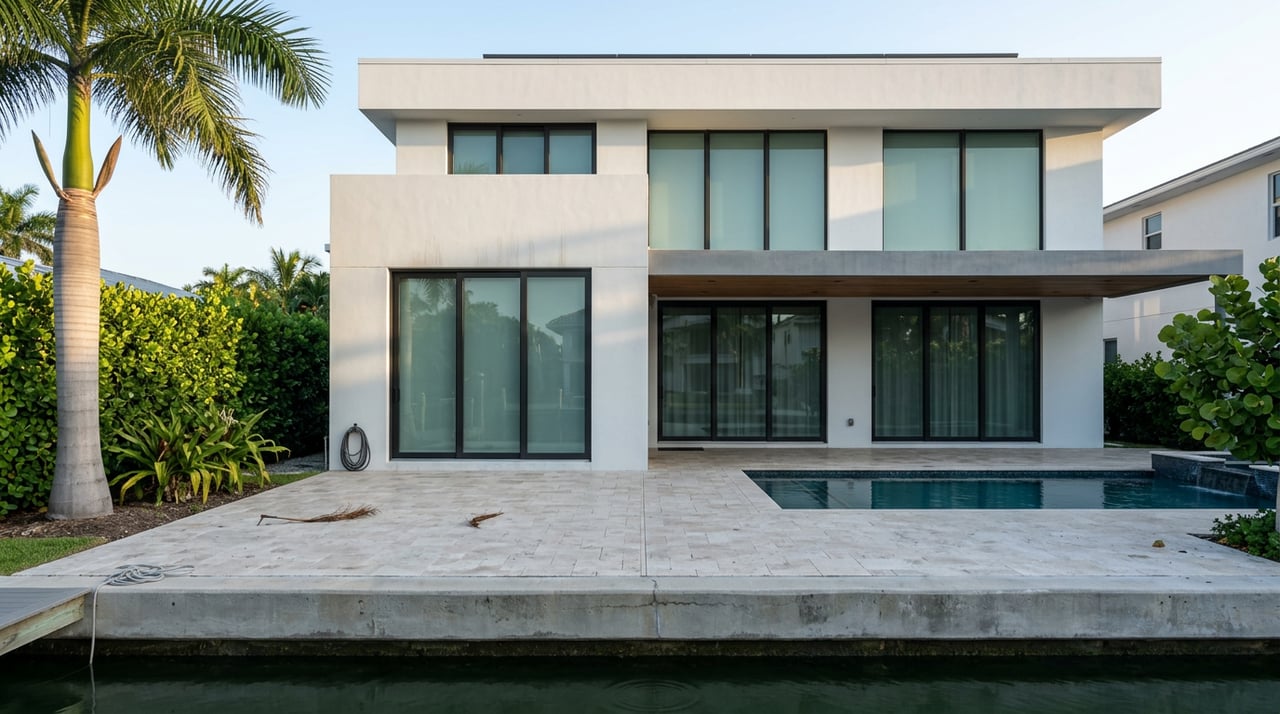
"What's going on with the Lighthouse Point Yacht Club?"
A resident asked this at a 2024 city commission meeting, as The New Pelican reported.
That question came seven years into a redevelopment that was originally supposed to take a fraction of that time. It matters to more than club members. The yacht club redevelopment has featured in comparisons between Lighthouse Point real estate and Las Olas Isles and Rio Vista. If you're comparing Lighthouse Point to those neighborhoods, the project's timeline, financing, permitting, and scope changes are part of the context alongside its planned amenities.
Nine Years From Purchase To Groundbreaking
Terry Paterson bought the roughly 10-acre Lighthouse Yacht Club Marina and Tennis Club site in July 2017 for $16 million. The original plan called for 22 luxury townhomes alongside a 43,000-square-foot clubhouse, budgeted at $32 million, with groundbreaking scheduled for early 2021.
That timeline didn't hold. Here's what actually happened between the purchase and the point where construction finally started:
- 2021 to 2022: The original construction loan went into default. A developer's agreement between Paterson and the city sat unsigned for three years while it moved between the planning and zoning board and the city commission. Paterson secured a permit to build a perimeter wall before the agreement was finalized, a move one commissioner questioned openly at a public meeting.
- 2023: Asbestos was discovered in the 60-year-old clubhouse, adding to the delay. Around the same time, the Pompano Beach fire marshal's office, which reviews Lighthouse Point's fire safety plans because the city doesn't have its own fire marshal, rejected the planning and zoning board's approved capacity of about 400 people and required the clubhouse be redesigned for almost 1,600.
- 2024: Paterson resubmitted clubhouse plans in May, still working through structural and fire review weeks later. A proposed amendment to the development agreement was retracted after Paterson concluded the formal review process would push any decision to September. A commission meeting on the issue ran more than two and a half hours, with residents voicing what local reporting described as frustration and fear about the project's pace.
- 2026: Construction is finally underway. Current marketing for the townhomes now advertises groundbreaking as complete, with only three of the original 21 residences still available.
Somewhere in that stretch, the project also changed shape. It went from 22 townhomes to 21, plus one single-family lot with a 100-foot slip. The clubhouse target capacity nearly quadrupled to satisfy fire code. None of that is unusual for a large private redevelopment. What's worth noticing is how long the gap ran between the original marketing and the version that's actually being built.
How the Project's Value Figures Compare
In a promotional post from this past May, the developer's team described the redevelopment's projected value at approximately $250 million, framing it as a driver of "long-term value within the area." Compare that to the $32 million figure the club's own materials used to describe the total project cost when it was first announced.
That's not appreciation. It's a different way of describing the project at a different stage. The $32 million figure was a construction budget aimed at commissioners and members weighing feasibility. The $250 million figure appeared in marketing at a private event held alongside the unveiling of an unrelated custom home. Both numbers can be technically defensible and still tell you very different things. If you're using either one to justify a purchase price today, you're borrowing a projection, not citing an appraisal.
One number that is grounded in something closer to a transaction: member initiation fees. The club's own materials note the non-refundable initiation fee, once a stabilized $7,500, is now estimated at $18,000 to $20,000 as the redevelopment proceeds. That's a real cost increase tied to a real project milestone, and membership demand held up even without a working clubhouse. By 2023, membership had already grown from 192 to roughly 400 despite the lack of amenities during the delay years, which tells you the underlying appeal of Lighthouse Point as a boating community never actually went away. What was missing was the building.
| Original Plan (2017-2021) | Current State (2026) | |
|---|---|---|
| Site purchase | $16 million (2017) | — |
| Residences | 22 townhomes | 21 townhomes plus 1 single-family lot |
| Total project cost | $32 million | ~$250 million (developer's projected value) |
| Member initiation fee | $7,500 stabilized rate | $18,000 to $20,000 |
| Groundbreaking | Scheduled early 2021 | Occurred roughly nine years after purchase |
What The Price Data Actually Shows Right Now
If the "next Las Olas Isles" narrative had already been priced in, you'd expect Lighthouse Point values to be climbing ahead of comparable Broward waterfront markets. That's not what current data shows.
As of July 2026, the citywide average home value sat at $771,700, up just 0.6 percent over the prior year. That same month, the citywide median list price was $975,000, or $480 per square foot, with homes spending a median of 151 days on the market, unchanged from July 2025. On the waterfront specifically, roughly 83 homes were listed at a median price of $799,000, with typical time on market around 105 days.
The data shows prices were essentially flat after years of fire code redesign and agreement review, even as construction got underway. That's not necessarily bad news for a buyer. Flat pricing during a build-out period is exactly the window where value hasn't caught up to a completed amenity yet, if the amenity gets completed on the timeline the developer now describes. It's also exactly the kind of setup where a buyer should confirm what's actually finished before paying for what's still promised.
What This Means If You're Comparing Neighborhoods
Lighthouse Point's real estate fundamentals don't depend on the yacht club succeeding. The city's deepwater canals, several with no fixed bridges to the Hillsboro Inlet, and established sections like Venetian Isles have carried their own value for decades independent of any single private club. That's worth separating from the club story when you're weighing Lighthouse Point against Las Olas Isles or Rio Vista. The canal infrastructure is real and already priced. The clubhouse is real now too, in the sense that it's finally under construction, but it is not yet delivering the resort-style amenities described in its marketing.
The club's own materials describe a roughly 28-month construction timeline to grand opening. A similar 27-month clock, written into the developer's agreement with the city, starts once demolition of the old clubhouse begins. Groundbreaking on the residential portion appears to have happened this year, which puts a realistic opening for the full clubhouse experience still a couple of years out from today. If you're buying with the expectation of walking into a finished 78-slip marina, tapas bar, and resort pool, you're buying ahead of the calendar, not behind it.
Common Questions
Do I have to join the yacht club to buy a home in Lighthouse Point? No. Lighthouse Point Yacht Club is a private, member-only club separate from general city residency. Most homes throughout the city, including many waterfront properties, have no connection to club membership.
How long before the new clubhouse actually opens? Based on the club's own previously stated construction estimate of about 28 months from the start of vertical construction, and given that groundbreaking on the residential portion occurred this year, a realistic opening for the full amenity package is likely still roughly two years out.
Has the rebuild moved home prices in Lighthouse Point yet? Not meaningfully as of mid-2026. The citywide average home value was up just 0.6 percent year over year in July 2026, and typical days on market were unchanged from a year earlier. Whatever premium the finished clubhouse eventually commands hasn't fully shown up in the data yet.
If you're weighing Lighthouse Point against other South Florida waterfront neighborhoods and want a clear-eyed read on what's finished, what's still in progress, and what that actually means for your offer, GK Group can walk through the comparison property by property. Request a confidential luxury market consultation before you let a marketing timeline set your price.