Ask three different public data sources for Golden Beach's median home price in 2026 and you'll get three different answers moving in three different directions. One shows closed sales up more than 20 percent over the past year. Another shows asking prices down 16 percent over the same window. A third shows list prices up nearly 16 percent. None of these trackers is wrong. They're all measuring a market that behaves nothing like the neighborhoods around it, and if you're comparing Golden Beach to a nearby condo corridor using the same yardstick you'd use anywhere else, you will draw the wrong conclusion.
Here is the pattern underneath the noise: prices are rising and homes are sitting. A closed-sales tracker showed a median sale price near $8.8 million for the three months ending May 2026, up 22.6 percent from the same period a year earlier. In the same window, the median sale price per square foot of the house itself fell nearly 40 percent. Meanwhile, a separate listing tracker put typical marketing time at 961 days as of August 2026, statistically unchanged from August 2025. Those two facts sitting together, price climbing while time-on-market stays flat and enormous, aren't a contradiction. They're the same story told twice.
A Market Too Small To Behave Like A Market
Golden Beach was incorporated in 1929 on a narrow barrier island between the Atlantic and the Intracoastal, and its charter has never allowed condominiums, hotels, or commercial development. Roughly 360 to 400 single-family lots exist inside the town's gates, and that ceiling has not moved in nearly a century. There is no new phase of construction adding inventory, no mixed-use tower delivering fresh units to widen the buyer pool. When a subdivision with thousands of homes sees its median move a few percentage points, that's a real signal about demand. When a town with a few hundred total properties sees its median move 20 points in either direction, it usually means a small handful of unusually large or unusually modest sales happened to close that quarter. A single $30 million estate changing hands can swing the whole town's median further than a hundred ordinary transactions would move a typical suburb's.
That's the mechanical reason three trackers disagree. They're each sampling from the same thin pool, just at different moments and different points in the pricing funnel, closed sales versus active listings versus new listings. None of them is measuring "the market" the way that phrase works in a place with real transaction volume.
Why Price Per Square Foot Stops Meaning Anything
In most South Florida markets, price per square foot is the fastest way to sanity-check a listing against its neighbors. In Golden Beach it tells you almost nothing on its own, because two houses on the same block can be priced for entirely different reasons. Completed homes have traded anywhere from roughly $800 to nearly $3,800 per square foot depending on whether the buyer values the existing structure or plans to tear it down and start over. A buyer purchasing to demolish is really pricing dirt, not drywall, and that buyer routinely pays $10 million to $15 million for the lot alone before spending another $10 million to $20 million on new construction.
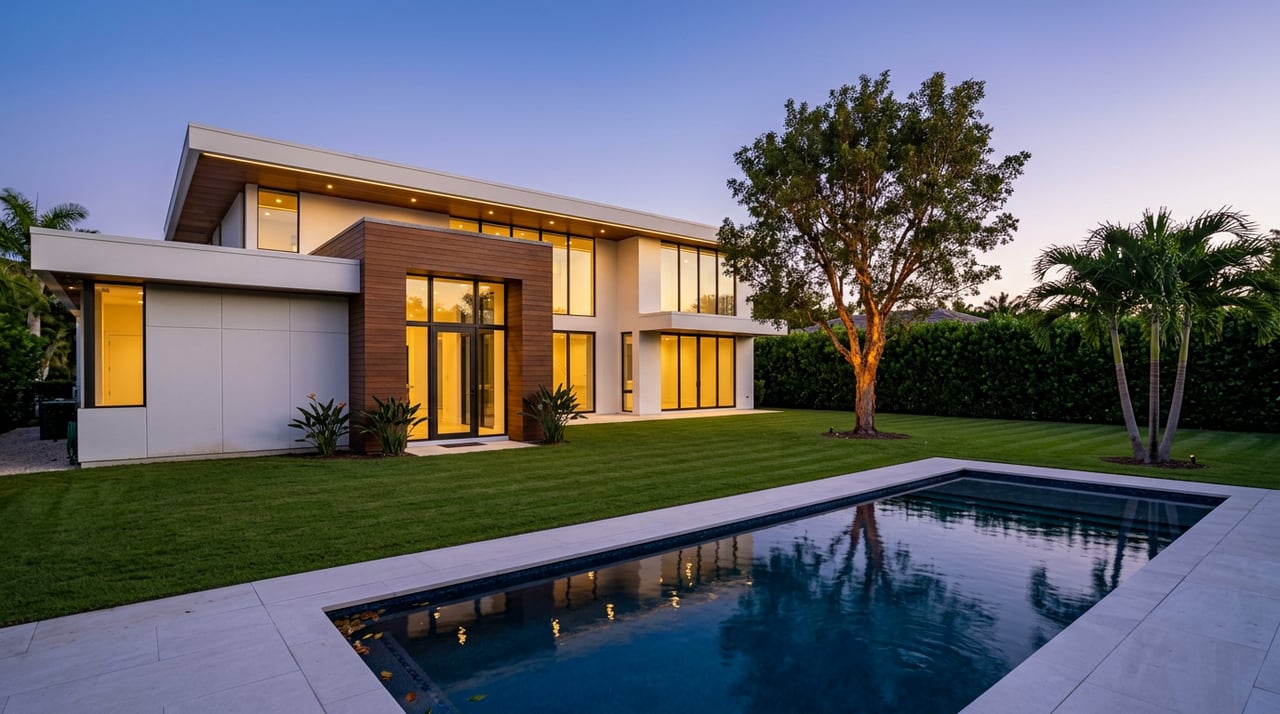
That split explains why Golden Beach is in the middle of a visible rebuild. Firms including Kobi Karp, Choeff Levy Fischman, and SDH Studio have shaped a run of new construction along the ocean side of town, replacing older Mediterranean and mid-century homes with contemporary estates. The clearest evidence of what this land is actually worth showed up in March 2026, when a property at 387 Ocean Boulevard sold for $30,375,000, the town's record. That number reflects frontage and buildable land as much as it reflects square footage of finished house.
Reading The Same Numbers Two Ways
| Metric | What it usually signals | What it signals in Golden Beach |
|---|---|---|
| Median sale price, quarter over quarter | Broad shift in buyer demand | A handful of closings, often skewed by one or two outlier estates |
| Price per square foot | A comp tool for judging value | Not comparable across listings, since the same dollar figure covers move-in condition and full teardowns |
| Days on market | Strength or weakness of demand | Reflects a pool of a few hundred owners, many of whom aren't under any pressure to sell regardless of price |
| Months of supply | Pace of absorption | Overstates on a base this small, where a few extra active listings can double the ratio without any real change in demand |
What Actually Explains The Long Marketing Times
Three structural facts, more than any softness in demand, explain why an industry analysis of mid-2026 data found oceanfront listings carrying a median time-to-sell near 689 days against a roughly six-month benchmark for a balanced market, with the town's overall months of supply near 22.
First, the supply cap means there is no competing new-construction pipeline pulling buyers toward fresher inventory the way there is in a high-rise corridor. Second, close to half of the town's homes function as secondary residences for owners who don't need to sell on any particular timeline, which removes urgency from a meaningful share of the seller pool. Third, and most correctable, is pricing mismatch: sellers who price a home against the cost of its finished structure, rather than the land underneath it, tend to sit for years. Sellers who price to the land floor the market has actually established tend to transact.
What This Means If You're Comparing Golden Beach To A Condo Neighbor
The town sits between Sunny Isles Beach and Hallandale Beach, both of which built vertically where Golden Beach did not. That adjacency makes for an easy but misleading comparison, because a condo tower and a single-family estate town are pricing two different things. A condo unit's value tracks the building: reserves, amenities, floor height, unit turnover. A Golden Beach estate's value tracks the land: frontage, buildable envelope, and how many other buyers are chasing the same finite strip of coastline. Comparing a per-square-foot figure across the two tells you almost nothing useful. Comparing what each dollar actually buys, ownership of a physical, non-replicable piece of oceanfront versus a share in a building, tells you a great deal.
Oceanfront carries one more real cost worth underwriting before an offer goes in. Flood insurance premiums in the highest-risk coastal zones of Miami-Dade can run from a few thousand dollars a year to well over $10,000, and federal coverage caps out well below what it would cost to replace a luxury structure. A current elevation certificate and a real insurance quote belong in the underwriting from day one, not after a contract is signed.
Common Questions
Why do different sources show Golden Beach prices moving in opposite directions in the same year? Because each source is measuring a different point in the transaction funnel, closed sales, active list prices, or new listings, off a base of only a few hundred total properties. A handful of large or small sales can move any one of those figures sharply without reflecting a real shift in the underlying market.
Does a rising median sale price mean it's currently a seller's market? Not on its own. A rising median next to months of supply well above balanced-market benchmarks points to a market where elevated prices coexist with listings that still take a long time to find the right buyer.
If price per square foot doesn't work here, what should I compare instead? Lot size, frontage, and whether the listing is priced against land value or against the cost of the existing structure. Those three factors explain more of the spread between comparable-looking Golden Beach listings than square footage ever will.
Golden Beach doesn't behave like the rest of the coastline because it was never built to. Understanding which numbers are noise and which one is the actual signal is the difference between overpaying for a structure and correctly valuing the land underneath it. If you're weighing a purchase or a sale in Golden Beach or comparing it against a neighboring waterfront community, GK Group can walk through what the current data actually supports for your specific property. Request a confidential luxury market consultation to start that conversation.
This article is general information, not legal, tax or financial advice. Consult a qualified professional about your situation.