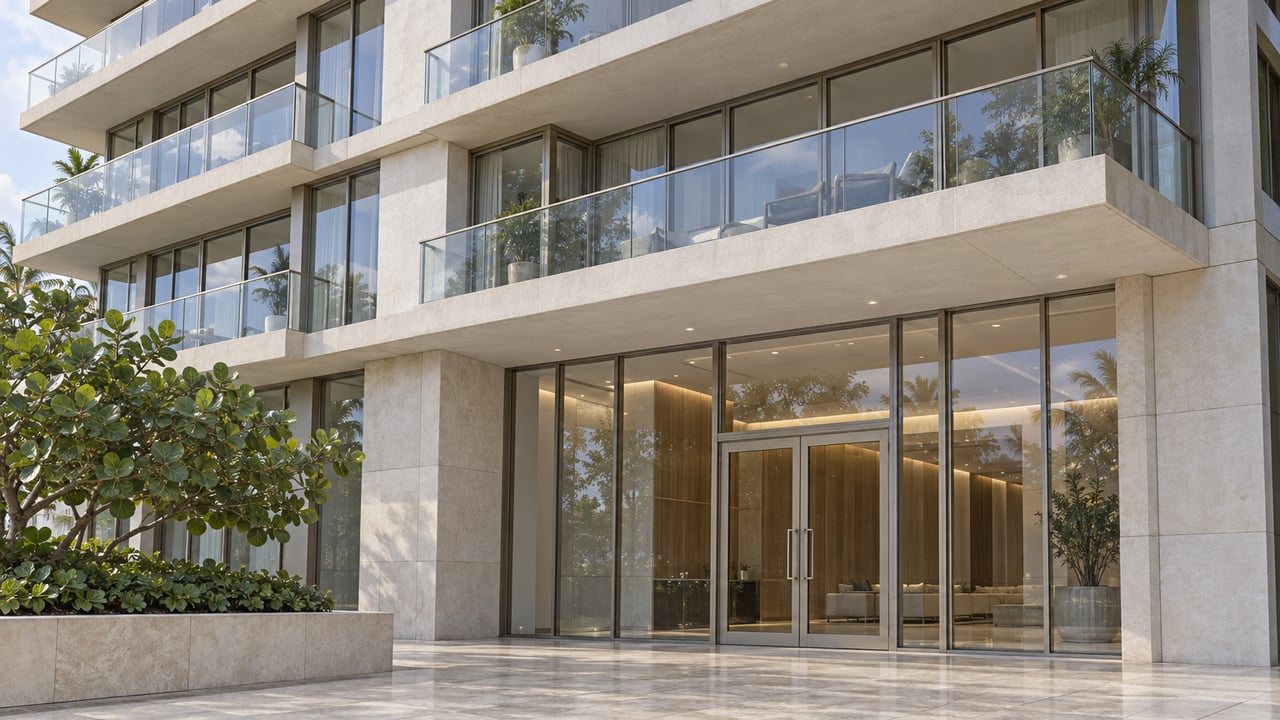
Walk south to north along A1A through Lauderdale-by-the-Sea and the skyline changes at almost exactly one point. South of Pine Avenue, nothing rises past three stories. The buildings sit low against the palms, Commercial Boulevard runs into the sand near Anglin's Square, and Aruba Beach Cafe still looks out at the water from roughly the same height it always has. Cross north of Pine and the profile shifts. Full-service towers with staffed lobbies and garage parking climb well past what anything to the south is allowed to build. Nobody planned this line to be a market boundary. It became one anyway, and it explains something about this town's real estate data that the median price on its own never will.
The Charter Provision Behind the Skyline
The height difference is not a quirk of the market. It is written into the town's own governing document. Since the early 1970s, Lauderdale-by-the-Sea's voters have limited the height of new development through the Town Charter to no more than three to four stories, and changing that limit requires another vote of the town, not a commission decision or a developer variance. The zoning code that implements the charter is specific: no building may be erected or altered to exceed three stories or 33 feet above grade in most of the town.
That single provision is why nobody today can quietly out-build the town's own skyline. A buyer touring the Old Town core is touring a market where the physical ceiling on new supply has been fixed by referendum for more than fifty years.
Why the North End Broke the Rule First
The exception exists because of timing, not exemption. In 2001, the town annexed a stretch of barrier island to the north, and several larger condominium buildings had already been built there under a different jurisdiction's rules before that annexation took effect. Those buildings kept their existing height and density as legal nonconforming structures. They are still standing today, and they still offer the kind of full-amenity oceanfront living, garage parking, staffed lobbies, pools, and security that a low-rise Old Town building typically cannot match.
What they cannot do is multiply. A comparable building could not be permitted at that height and density under the town's current rules. The inventory north of Pine Avenue is functionally a closed set. Every unit in one of those towers is scarce in a way that has nothing to do with buyer demand and everything to do with a permitting ceiling that predates most of today's owners.
That is the mechanism worth understanding before you compare listings across this town. It is not two neighborhoods with different tastes. It is one small town with two supply curves, one of them fixed by grandfather clause and one of them capped by charter, and neither one can expand to meet the other.
The Numbers That Don't Agree With Each Other
Here is where the mechanism shows up in the data, and where a portal search bar will mislead you if you take the headline median at face value.
| Segment | Reporting window | Months of supply | Market position | Median sale price |
|---|---|---|---|---|
| Town-wide condo market | Trailing six months, reported spring 2026 | 13.8 | Equilibrium | Declined year over year |
| Oceanfront condo segment | First half of 2026 | 7.2 | Seller advantage | $630,000 |
| Oceanfront condo segment | Through August 2026 | 8.4 | Seller advantage | $560,000, down 7.8% year over year |
Read across that table and the town-wide figure looks nothing like the oceanfront-specific figure reported in the same year. The blended condo market carries nearly double the months of supply of the beachfront segment and is described as softening, while the beachfront-specific tracking has stayed in seller-advantage territory for most of 2026. That gap is the north-south split showing up as a statistic. A large share of the town-wide inventory sits in the more elastic Old Town core and inland pockets, where new listings can still enter the market within the existing height limit. The oceanfront segment is disproportionately made up of that fixed, non-replicable stock north of Pine Avenue, so it behaves like a market where supply cannot chase demand.
Notice something else in that table. The oceanfront segment's own median moved from $630,000 in the first half of 2026 to $560,000 in the report covering data through August, a swing of $70,000 inside the same calendar year on what is nominally the same slice of the market. That is not a market correction. It is what happens when a segment is thin enough that the specific handful of units that closed in a given window can move the median on their own. Local market trackers flag this directly: because this is a smaller market, changes in the size and mix of units sold can swing short-term pricing and sales statistics more than they would in a deeper market like Fort Lauderdale Beach or Galt Ocean Mile.
What This Means If You're Comparing Neighborhoods
If Lauderdale-by-the-Sea is on your shortlist against Fort Lauderdale Beach, Galt Ocean Mile, or Pompano Beach, the question to ask before you trust any single median is which side of Pine Avenue a given listing sits on, and what that building's construction history actually is.
A few practical checks follow directly from the mechanism:
- Ask whether the building predates the 2001 annexation and holds nonconforming status. That status is what makes its height and density legally permanent, not a feature that a newer building nearby can replicate.
- Treat a low months-of-supply reading in the oceanfront segment as a structural scarcity signal, not a temporary squeeze that will ease once more listings come to market. There is no zoning path for that inventory to grow.
- Treat the town-wide condo figure as a blend, not a single market. It mixes the fixed high-rise stock with the more elastic low-rise stock south of Pine Avenue, and the two do not move together.
- Expect the oceanfront median itself to swing meaningfully from one reporting period to the next, simply because so few units close in any given window. A $70,000 shift in six months here is closer to normal than alarming.
The Old Town Trade You're Actually Making
None of this makes the low-rise core a lesser option. It makes it a different one. South of Pine Avenue, the trade is scale for character. Buildings like Villas By The Sea sit a block from Anglin's Square, where a fishing pier still anchors the town's identity and a walk to Commercial Boulevard passes Sea Ranch Center, El Prado Park, and Laura Ward Park before it reaches the water. That is a town where daily life still happens on foot, and where a three-story cap has preserved a scale that most of coastal Broward gave up decades ago. What that district gives up in amenity depth and unit scarcity, it makes up in the kind of walkable, small-building intimacy that is the entire reason people move to a town this size in the first place.
North of Pine Avenue, the trade runs the other way. A buyer there is paying for the fixed scarcity of a grandfathered tower, for a lobby staffed at the front door and a garage instead of street parking, for a building type that cannot be built again under current rules. Both are legitimate reasons to buy here. They are just not the same market, and no single median price will tell you which one you are actually shopping.
Common Questions
Does the three-story height limit apply to single-family homes, or only condominiums? The charter provision governs new development townwide, not condominiums specifically, so new construction on a single-family lot is subject to the same general height ceiling, alongside separate setback and lot coverage rules that apply to residential parcels.
Could an older low-rise building south of Pine Avenue eventually be rebuilt taller? Not under the current charter. The height limit can only be changed by another town-wide vote, and the ordinance preserves nonconforming height solely for buildings that already exceeded today's limit before the rule took effect, which is why the advantage sits with existing towers north of Pine Avenue rather than anything built or rebuilt today.
Is the price difference between the two ends of town just a matter of size? Size is part of it, but the deeper difference is product type. North of Pine Avenue you are largely buying into full-service, amenity-rich towers with a fixed and non-expanding unit count. South of it you are buying into a walkable, low-rise district where new listings can still enter the market within the existing height cap, which keeps that segment more price-sensitive and harder to read as a single scarce asset class.
If you are weighing a purchase in Lauderdale-by-the-Sea against another stretch of the Northeast Broward coast, the building's history matters as much as its listing price. GK Group works this coastline building by building, not just by median, and can walk you through what a specific address's zoning status actually means for your offer. Request a confidential luxury market consultation before you write one.