Miami-Dade County reopened its Condominium Special Assessment Loan Program for exactly one month this year, from June 1 through June 30, 2026, with about $15 million in funding behind it. If you own a unit in an aging oceanfront tower and you're staring down a six or seven figure special assessment for structural repairs, that program sounds like the backstop everyone in this market has been waiting for since the wave of post-Surfside inspections began. For most owners in Sunny Isles Beach, it isn't. The loan requires the unit to be your primary residence, and Sunny Isles Beach is a market built on units that aren't.
That mismatch matters more here than almost anywhere else in Miami-Dade, and it changes how a buyer should read a resale listing, an estoppel letter, or a building's reserve study before writing an offer.
A Program That Opens for Thirty Days at a Time
The county's assistance program isn't a standing fund. It paused in August 2025 so the Housing and Community Development department could rebuild it as a fully digital application system, then relaunched with a hard window: applications accepted online only, from June 1 to June 30, 2026, processed in the order received, with priority given to owners age 62 and older. Before the pause, the program had closed nearly 1,500 loans totaling close to $40 million, and by the time of the relaunch announcement it had provided more than $55 million in assistance total.
The terms of the loan itself are specific. Qualifying owners can receive up to $50,000, structured as low or no-interest financing tied to income, capped at 140 percent of area median income. The unit has to be the owner's primary residence. Investment properties are explicitly excluded. Miami-Dade County Mayor Daniella Levine Cava framed the redesign around a particular resident:
"By refining and strengthening the application process, we're making sure we continue to serve our most vulnerable residents, especially older adults, with fairness, efficiency, and dignity."
That's a real and worthwhile goal. It's also a description of a household that doesn't match the typical owner in most of Sunny Isles Beach's oceanfront stock.
Who Actually Owns These Units
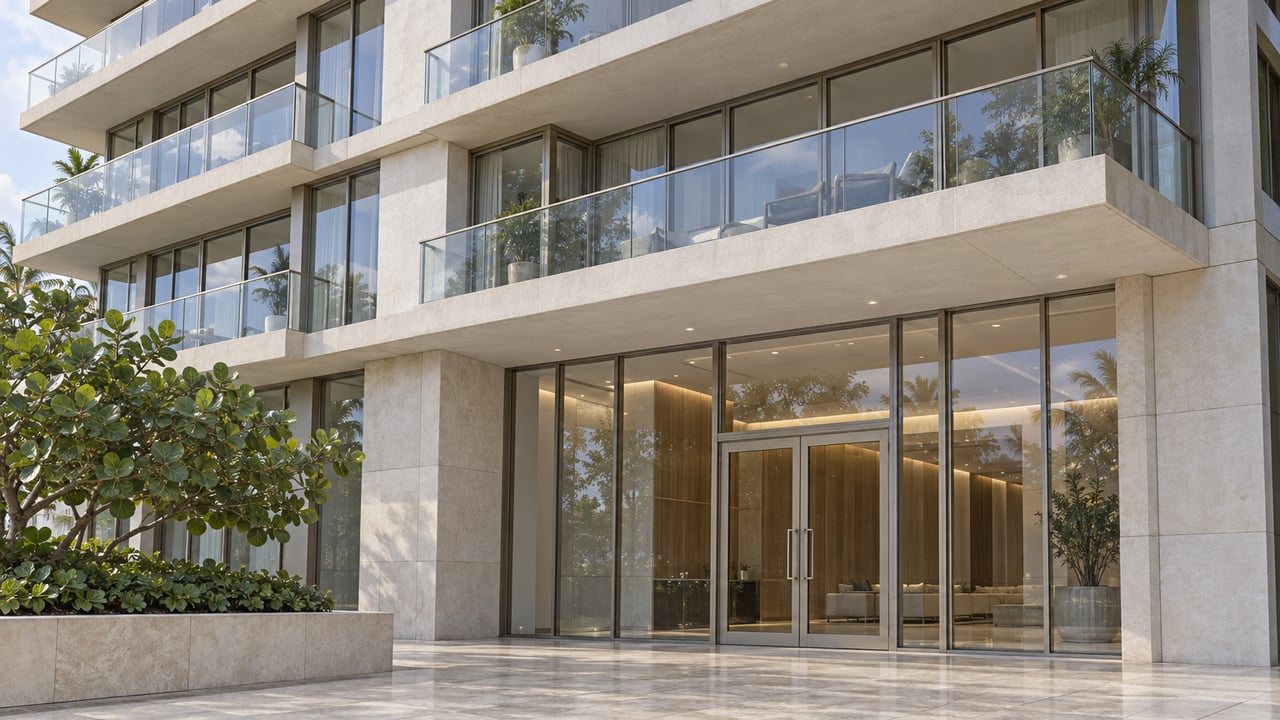
Sunny Isles Beach markets itself on precisely the profile the loan program excludes. Its inventory runs from Porsche Design Tower, where active resale listings this year have ranged from $3.7 million to $14.6 million, to the Estates at Acqualina, a two-tower, 265-residence development completed in 2022 that has produced a widely reported $27 million penthouse sale. Pre-construction towers now under development, including Bentley Residences with its in-residence car elevator concept and the twin 62-story St. Regis Residences towers designed by Arquitectonica, are being sold explicitly as second homes, winter addresses, and lock-and-leave properties for a global buyer base. None of that is a primary residence in the sense the county's loan program requires.
That doesn't mean every unit in Sunny Isles Beach is untouched by the primary-residence carve-out. Older, smaller buildings away from the ultra-luxury towers do house year-round residents, including long-time owners who would qualify. But the buildings generating the largest special assessments, the tall, amenity-heavy oceanfront towers built between the 1980s and 2000s that are now hitting 30-year milestone inspection thresholds and 40-year recertification requirements under state law, skew heavily toward exactly the ownership profile the program can't reach.
| Loan Program Requirement | Typical Sunny Isles Beach Tower Owner |
|---|---|
| Must be primary residence | Often a second home, pied-a-terre, or investment unit |
| Household income under 140% AMI | Buyer pool skews toward $1M+ purchases |
| Investment properties excluded | Global and out-of-state ownership is common in oceanfront towers |
| Application window limited to one month a year | Assessment notices arrive on the building's timeline, not the county's |
Where the Cost Actually Lands
Special assessments in Florida condos are allocated by each unit's percentage interest in the common elements, set out in the declaration and bylaws. There's no means-tested cushion built into that formula. When a board levies an assessment to fund a milestone inspection repair or a Structural Integrity Reserve Study shortfall, every owner pays their share regardless of whether the unit is a primary residence, a rental, or vacant nine months a year. For the owner who qualifies for the county loan, that's a real, if narrow, source of relief. For everyone else, and in Sunny Isles Beach that's most of the building, the assessment is simply due.
This is the detail a buyer needs before closing, not after. An estoppel or resale certificate will show current and pending assessments. A recent reserve study will show whether the building is funding routine wear or catching up on deferred maintenance. Board minutes from the past year or two will show whether a special assessment has already been discussed and how large it's expected to be. None of those documents will mention the county loan program, because for the overwhelming majority of Sunny Isles Beach buyers, it's not part of the equation.
What Happens When the Math Doesn't Work
Sometimes the numbers on an aging building stop making sense as a recertification project and start making sense as a sale. The Miami Beach Club, a two-story, 108-unit building completed in 1951 on roughly two oceanfront acres, is the clearest recent example. Rather than fund the kind of structural work an aging low-rise near the water eventually requires, its owners sold the site in 2025 for approximately $131.8 million to a partnership of the Related Group, Dezer Development, and BH Group. In February 2026, the Sunny Isles Beach City Commission approved the site for a new 62-story, 820-foot tower with 145 residences, ranging from three to six bedrooms and including full-floor penthouses at the top.
That outcome is not available to every building, and it's not guaranteed even where land values support it. But it's a live illustration of the fork aging towers face here: absorb rising assessment and insurance costs unit by unit, or become attractive enough as a redevelopment site that a buyout replaces the repair bill entirely. Buyers evaluating an older Sunny Isles Beach tower are, whether they realize it or not, making a bet on which direction that particular building is headed.
Pricing the Risk Before You Write the Offer
The caution this creates is already visible in how Sunny Isles Beach condos are trading. Days on market for luxury condos here averaged 135 to 138 days from the fourth quarter of 2025 through the first quarter of 2026, the longest of any major Miami luxury submarket, compared with 65 days in Edgewater over the same stretch. The median sale price for luxury condos reached $1,350,000 as of the most recent trailing data reported in the second quarter of 2026, up 6.2 percent year over year, so this isn't a market losing value. It's a market where buyers are taking longer to commit. At the $5 million and above tier, some resales have closed at roughly a 10 percent discount to original asking price, while pre-construction towers like Bentley Residences and the St. Regis Residences, where the North Tower's groundbreaking was slated for 2026, are seeing no such negotiation room.
Read together, that split tells you where the assessment question is already being priced in. Buyers willing to spend months in due diligence on a completed resale tower are, in effect, buying time to review engineering reports and reserve studies before committing, and sellers who price accurately for that scrutiny are the ones transacting. New construction carries none of that overhang, because there's no deferred maintenance to inherit, which is part of why buyers are paying full price there and negotiating hard everywhere else.
If you're looking at a resale unit in a tower built before the 2000s, ask for the building's most recent milestone inspection or 40-year recertification report before you get attached to the view. Ask whether a special assessment has already been approved, is under board discussion, or hasn't been raised yet because the reserve study hasn't been updated. And don't assume a county loan program will soften the number. In this market, it almost certainly won't apply to you.
If you're weighing an older Sunny Isles Beach tower against new construction, or want a second set of eyes on a building's assessment history before you make an offer, GK Group can walk the reserve study and board minutes with you line by line.